

2026 Mazda3 Sedan
| Sales | ||
| Day | Open | Closed |
| Monday | 9:00AM | 8:00PM |
| Tuesday | 9:00AM | 8:00PM |
| Wednesday | 9:00AM | 8:00PM |
| Thursday | 9:00AM | 8:00PM |
| Friday | 9:00AM | 8:00PM |
| Saturday | 8:00AM | 7:00PM |
| Sunday | Closed | Closed |
2026 Mazda3 Sedan for a Drive That Feels Clear and Connected
The 2026 Mazda3 Sedan speaks to drivers who want their time behind the wheel to feel clear, composed, and connected. Its appeal reaches beyond a clean shape or a long equipment list. The greater question is whether the car responds naturally to your inputs, places key controls where you expect them, and gives you the right mix of comfort, power, and technology for the roads you travel most.
That makes configuration worth careful thought. The Mazda3 Sedan lineup gives you choices in trim, drivetrain, cabin equipment, and power delivery. A front wheel drive model may suit someone focused on efficient commuting and a lower entry point. Available i Activ AWD changes the equation for a driver who wants power sent across all four wheels. Turbocharged models move farther toward stronger acceleration. Upper trims add features that can reshape how the cabin feels during a commute or longer trip.
The goal is not to select the longest feature list. It is to identify which version supports the way you drive, where you spend your time, and which details you will notice after the first few weeks of ownership.
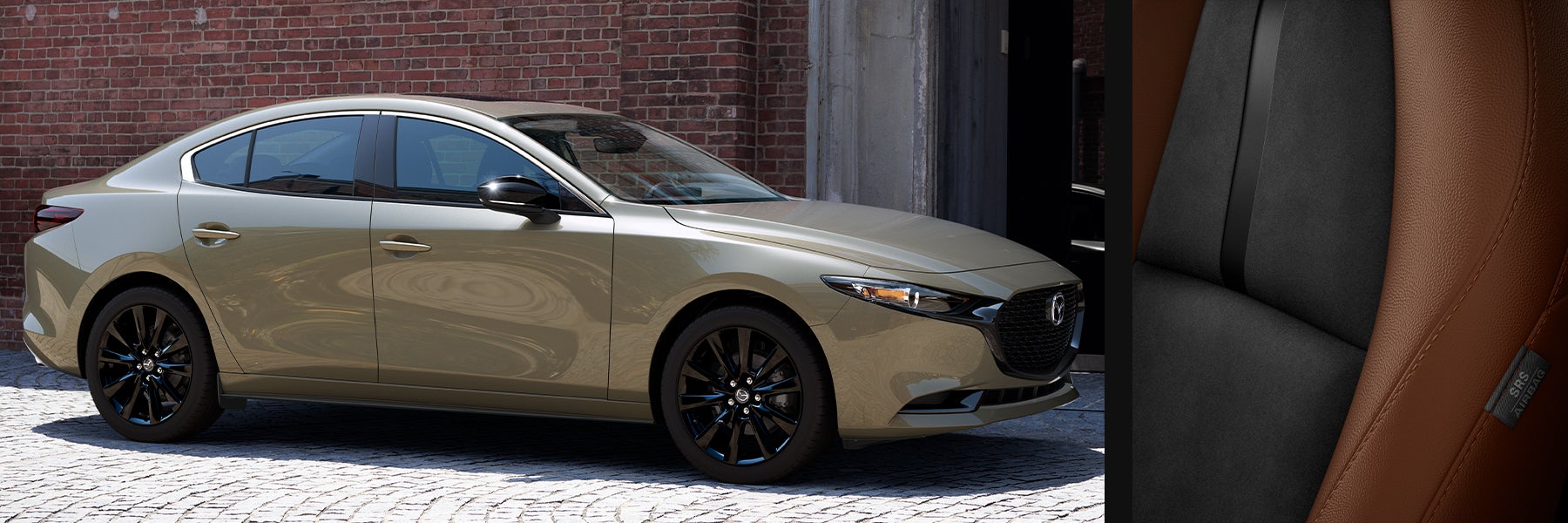
A Compact Sedan Shaped Around the Driver
The Mazda3 Sedan begins with a simple idea: the car should feel natural from the driver’s seat. Steering response, seating position, pedal placement, visibility, and control layout all contribute to that relationship. Mazda’s Jinba Ittai philosophy gives that relationship a name, but the useful test is direct. Sit in the car, adjust the seat and mirrors, place your hands on the wheel, and notice how little effort it takes to settle in.
That focus gives the sedan a distinct identity within compact car shopping. Some vehicles place greater emphasis on maximum screen area, rear cargo access, or a softer road feel. The Mazda3 asks a different question. Do you want a compact sedan that keeps you engaged with the act of driving while still supporting commuting, errands, passenger trips, and highway travel?
The exterior shape carries the same restraint. Clean surfaces and controlled proportions give the sedan a mature presence without relying on excessive visual detail. Inside, the layout keeps attention centered around the driver. The result may appeal to someone who values calm design and clear interaction more than a cabin filled with competing visual elements.
Your first evaluation should focus on the relationship between seat, wheel, pedals, mirrors, and primary controls. Those details are difficult to judge from a specification chart, yet they shape every mile after purchase.
Choose the Powertrain by What You Want to Feel
The 2026 Mazda3 Sedan uses a SKYACTIV G 2.5 liter four cylinder as the foundation of the lineup, with standard output reaching 186 horsepower and 186 pound feet of torque. Turbocharged versions raise the available output and change the sedan’s acceleration character. The choice is less about chasing the largest number and more about deciding how much reserve power you want when merging, passing, or accelerating out of slower traffic.
The standard 2.5 liter setup makes sense for a driver who values predictable response and wants to keep the purchase decision centered on trim equipment, fuel use, and cabin features. During a test drive, pay attention to how the car responds from a stop, how the transmission reacts when you ask for more speed, and whether highway merging feels natural with your driving style.
Available i Activ AWD introduces another choice. A shopper should consider it for the way power delivery feels across the vehicle, then weigh that against price and fuel economy differences. Jacksonville does not bring a winter snow question into the center of the decision, so AWD should earn its place through your own priorities instead of through a generic assumption that more driven wheels are always necessary.
Turbocharged configurations create a stronger shift. Additional output can make passing and acceleration feel more immediate, but the move upward also changes cost and fuel economy. A driver who spends most trips in steady commuting may decide the standard engine already provides the response they want. Someone who places greater weight on stronger acceleration may reach a different conclusion.
Before choosing, evaluate three points:
- Response from low speed without flooring the accelerator
- Transmission reaction during a highway merge
- Steering and power delivery through a familiar curved road
Those checkpoints reveal more than a horsepower figure alone.
Find the Trim Where the Right Features Arrive
Trim selection is where the 2026 Mazda3 Sedan requires the most discipline. The lineup moves through several equipment levels, and each step should solve a clear need before it earns a higher place on your list.
The 2.5 S establishes the core sedan. From there, the 2.5 S Select Sport adds cabin and convenience upgrades that can make sense for someone who wants a stronger equipment set without moving far up the range. Current 2026 trim information identifies features such as 18 inch alloy wheels, leatherette trimmed sport seats, and dual zone automatic climate control within the Select Sport step.
The 2.5 S Preferred deserves closer attention for shoppers researching a mid trim Mazda3. It adds items such as heated front seats, a power sliding glass moonroof, and an 8 way power driver seat with memory. Those additions are more than decorative. A power seat can make repeated position adjustments easier in a shared vehicle. Memory settings carry greater relevance when two drivers use the car. Heated seats may carry less weight in Northeast Florida than in a colder region, while the moonroof may matter more to someone who values natural light.
That is the point of a mid trim decision. You should be able to name the feature that justifies the step.
Higher configurations move into different territory through AWD availability, distinct appearance treatments, stronger turbocharged output, and broader cabin equipment. A shopper drawn to the Carbon Edition or a turbo model should ask whether the attraction comes from a specific drivetrain goal, a cabin preference, acceleration response, or appearance. When the answer is clear, the step upward is easier to defend.
Use a simple trim filter:
- Start with the features you use every week.
- Separate comfort priorities from appearance preferences.
- Identify whether AWD belongs in your decision.
- Decide whether standard engine response is enough before pricing turbo models.
- Compare the exact vehicles in stock because equipment and configuration must match the individual unit.
The right stopping point is the trim where the next step adds items you would rarely use or does not change the drive in a way you care about.
Evaluate the Cabin From the Seat You Will Use Most
A compact sedan can look inviting in photos and still miss the mark once you spend an hour inside it. The Mazda3 cabin should be judged through physical interaction.
Begin with the driver seat. Set the distance to the pedals, adjust seatback angle, position the steering wheel, and then check mirror coverage. Notice whether you can reach the primary controls without shifting your upper body. Look at the path from the road to the instrument display and back again. The aim is a cabin that asks less of your attention during routine tasks.
Passenger fit deserves equal scrutiny when the car will carry adults in the rear. The Mazda3 Sedan seats five, but compact exterior dimensions create real tradeoffs. A driver who frequently carries taller rear passengers should test knee room and headroom with the front seat already adjusted for the primary driver. Do not judge the rear seat with the front seats pushed unrealistically forward.
Material choice also changes as you move through the trim range, but touchpoints matter more than broad labels. Pay attention to the steering wheel, seat surface, armrest position, door pull, climate controls, and areas your hands contact throughout the week.
For someone cross shopping compact cars, the Mazda3 may stand out through visual calm and a driver centered layout. Another sedan may offer a different rear seat package or place more controls on a touchscreen. Neither approach wins automatically. The stronger fit is the one that matches how you sit, reach, carry passengers, and divide attention while driving.
Test the Technology With Your Own Phone and Routine
Technology should reduce friction between starting the car and getting on the road. That makes a live test more useful than reading a feature list.
Bring the phone you use every day. Pair it with the vehicle. Open your preferred navigation app, start an audio source, place a call, and move between menus. Check whether the control method feels natural while seated in a normal driving position. Mazda’s interface philosophy has long placed attention on deliberate interaction, and the Mazda3 offers connected features that vary by trim and configuration.
Do not stop at whether Apple CarPlay or Android Auto is present. Ask how quickly you can reach the functions you use most. Check voice control. Adjust audio. Return to the main vehicle interface. Have a second regular driver repeat the same process.
The strongest technology choice is the one that fades into the drive once your routine is established.
Think About Sedan Space in Terms of What You Carry
The Mazda3 Sedan uses a traditional trunk, which creates a different loading pattern from the Mazda3 Hatchback. The sedan offers 13.2 cubic feet of cargo volume and a 60/40 split fold down rear seatback, giving you a defined trunk area with the option to extend space for longer items.
The number is only a starting point. Open the trunk and evaluate the opening shape, floor area, hinge intrusion, and the size of items you carry most. A commuter with a work bag and groceries asks very little of the space. A household carrying a stroller, sports gear, large luggage, or bulky home purchases should test those needs more carefully.
The sedan body also offers a separation between passenger cabin and cargo area that some drivers prefer. The hatchback answers a different need through a larger rear opening and taller loading area. For someone already committed to the sedan, the decision comes down to whether the trunk shape works with the objects that appear in your life throughout the week.
Bring measurements when a specific item has to fit. Better yet, bring the item when possible.
Consider How the Mazda3 Fits Jacksonville Driving
Jacksonville places a compact sedan across several distinct trip patterns. A weekday may involve Atlantic Boulevard traffic, a bridge crossing, parking near a busy commercial area, and a longer highway stretch before the car returns home. Weekend travel can add coastal roads, trips toward the Beaches, or longer drives beyond Duval County.
The Mazda3 Sedan’s size can make parking and urban movement easier to judge than in a larger crossover, while its available drivetrain and powertrain choices let the shopper decide how much additional traction or acceleration they want. Fuel economy should remain part of that discussion because the published ratings vary by configuration.
For a Jacksonville shopper, the strongest test route should include more than a short loop around the dealership. Include a low speed section, a highway merge, a rougher stretch of pavement, and enough time to judge seat comfort. The car should make sense across the trips you repeat, not only during the first few minutes behind the wheel.
Make the Final Choice by Testing What You Will Notice Every Week
The 2026 Mazda3 Sedan makes the strongest case when the configuration matches the driver instead of the longest available equipment list. Start with the standard engine and decide whether its response satisfies you. Move to AWD only when you can identify what you want from that drivetrain choice. Consider a turbo configuration when stronger acceleration carries enough weight to justify the higher step. Choose a trim because its added equipment solves a recurring need.
Then return to the cabin. Check your seating position. Test rear passenger fit. Pair your phone. Use the controls. Open the trunk. Drive on roads that resemble your routine.
A specification sheet can narrow the field, but it cannot tell you whether the steering feels natural in your hands, whether the seat supports your preferred posture, or whether a specific trim adds the details you will appreciate every week. Those answers come from comparing the right configurations with a clear sense of what matters to you.
At Tom Bush Mazda in Jacksonville, the next step is to evaluate the 2026 Mazda3 Sedan as a complete fit: the way it responds, the way the cabin supports you, and the way each trim changes the car you will live with.
Does the 2026 Mazda3 have auto start stop?
Equipment should be verified on the exact 2026 Mazda3 Sedan configuration you are considering. Powertrain technology can vary by vehicle specification, so check the window sticker and current Mazda information for the individual unit before purchase.
Does the 2026 Mazda3 have remote start?
Remote start access may be available through Mazda Connected Services on an equipped and enrolled vehicle. Before purchase, verify the exact vehicle’s connected service eligibility, activation requirements, compatible phone setup, and any applicable trial or subscription terms so you know how the feature will work after delivery.
How well does the 2026 Mazda Mazda3 hold its value?
Future resale outcomes are shaped by mileage, age, service history, accident history, local demand, configuration, exterior and interior state, and broader used vehicle pricing. A shopper concerned about depreciation should compare projected figures across the exact trim and drivetrain choices under consideration instead of assuming every Mazda3 configuration will follow the same path.
Why does Mazda still offer a manual transmission in the Mazda3?
A manual transmission preserves a more direct form of driver involvement by giving the driver control over gear selection and clutch engagement. Availability is tied to specific Mazda3 body style and trim configurations, so shoppers seeking a manual should confirm the current 2026 lineup instead of assuming it is offered across every sedan and hatchback version.
(Note: This page provides general information and does not mention specific pricing. For details about financing and car buying, please reach out to our dealership.)