

Mazda approaches safety with the same philosophy it applies to design and driving feel. Rather than trying to replace the driver, Mazda builds systems that support awareness, reduce fatigue, and step in only when necessary. This approach is embodied in i-Activsense, Mazda’s suite of advanced driver assistance technologies designed around human behavior, not automation.
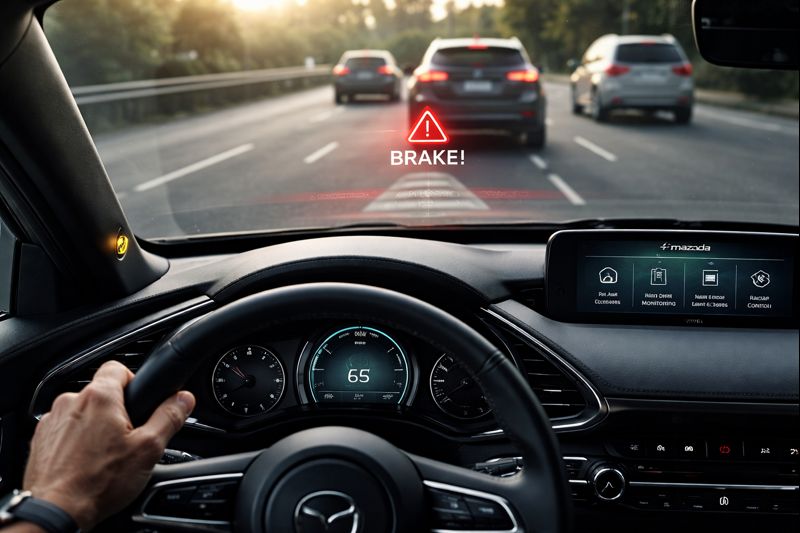
i-Activsense is best understood as layered safety. Each system plays a specific role, escalating from awareness to assistance to intervention depending on the situation. The goal is not to take control away from the driver, but to help the driver stay informed, focused, and confident in real-world driving conditions.
Active Safety Versus Passive Safety
Mazda safety is built on two complementary foundations.
Passive safety focuses on protecting occupants when a collision occurs. This includes the vehicle’s body structure, airbags, seatbelt systems, and energy-absorbing materials.
Active safety focuses on helping drivers avoid collisions in the first place. i-Activsense lives in this category, using sensors, cameras, and radar to monitor conditions and support driver decision-making before an accident happens.
Mazda places particular emphasis on active safety because preventing an incident is always preferable to mitigating one.
How i-Activsense Works at a System Level
i-Activsense systems rely on a combination of forward-sensing cameras, radar units, and vehicle control modules. These components continuously analyze vehicle speed, steering input, surrounding traffic, lane markings, and relative distance to objects.
What separates Mazda’s approach is calibration. Systems are tuned to feel natural and predictable, avoiding abrupt corrections that can startle drivers or create new hazards. Alerts are designed to inform first, assist second, and intervene only when the risk becomes imminent.
Mazda Smart Brake Support
Mazda Smart Brake Support is the foundation of i-Activsense. It monitors the road ahead using cameras and radar to detect vehicles, pedestrians, and potential obstacles.
The system operates in stages:
- Visual and audible alerts warn the driver of a possible collision
- Brake assist increases braking force if the driver reacts but does not brake firmly enough
- Automatic braking engages only if the system determines a collision is likely and the driver does not respond
This escalation allows the driver to remain in control while providing a safety net in critical moments.
Blind Spot Monitoring and Rear Cross Traffic Alert
Blind Spot Monitoring tracks vehicles approaching from adjacent lanes using rear-mounted radar sensors. When a vehicle enters a monitored zone, the system provides a visual alert in the side mirror.
Rear Cross Traffic Alert extends this concept when reversing out of parking spaces. It scans left and right for approaching traffic and issues warnings to help prevent low-speed collisions in crowded areas.
These systems focus on situational awareness rather than intervention, supporting driver judgment in environments where visibility is naturally limited.
Lane Departure Warning and Lane Keep Assist
Mazda differentiates between warning and assistance. Lane Departure Warning alerts the driver if the vehicle begins to drift without a turn signal. Lane Keep Assist adds gentle steering input to help guide the vehicle back toward the center of the lane.
Importantly, Mazda avoids aggressive steering correction. The system is designed to support attentive driving, not override it. Drivers still feel fully engaged with the vehicle, which reinforces trust rather than dependence.
Mazda Radar Cruise Control
Mazda Radar Cruise Control maintains a set speed while adjusting following distance based on traffic conditions. Using radar and camera input, the system can slow the vehicle as traffic slows and resume speed when conditions clear.
Unlike some systems that prioritize automation feel, Mazda tunes adaptive cruise control to maintain smooth, predictable behavior. Acceleration and braking inputs are gradual, reducing fatigue during long highway drives while keeping the driver mentally engaged.
Driver Attention and Awareness Philosophy
A defining characteristic of i-Activsense is Mazda’s emphasis on keeping drivers mentally present. Systems are designed to complement natural driving behavior rather than encourage disengagement.
Mazda avoids positioning these technologies as autonomous driving features. Instead, they are framed as tools that enhance awareness and provide backup support when attention lapses momentarily.
This philosophy aligns with Mazda’s broader human-centered design approach, where safety, control, and driving enjoyment coexist rather than compete.
Understanding System Limitations
Mazda is transparent about the limits of driver assistance technology. i-Activsense systems depend on clear lane markings, visible road conditions, and properly functioning sensors. Weather, road debris, and unusual traffic patterns can affect performance.
Drivers remain responsible for monitoring surroundings and maintaining control of the vehicle at all times. Understanding these limitations is essential for using the systems effectively and safely.
Why Mazda’s Safety Approach Builds Confidence
Rather than overwhelming drivers with intrusive alerts or overly aggressive corrections, Mazda’s safety systems feel subtle and intuitive. This builds trust over time, encouraging drivers to stay engaged rather than rely on automation.
The result is a safety experience that feels integrated into the act of driving. Alerts arrive when they matter. Assistance feels supportive rather than corrective. Intervention occurs only when risk becomes immediate.
The Bigger Picture of Mazda Safety
i-Activsense is not about removing the driver from the equation. It is about reinforcing good driving habits, reducing cognitive load, and providing intelligent support in complex situations.
For drivers who value awareness, control, and confidence behind the wheel, Mazda’s approach to safety feels intentional and respectful. It reflects a belief that the safest driver is an informed, engaged one, supported by technology that knows when to help and when to stay out of the way.
Connect with us


